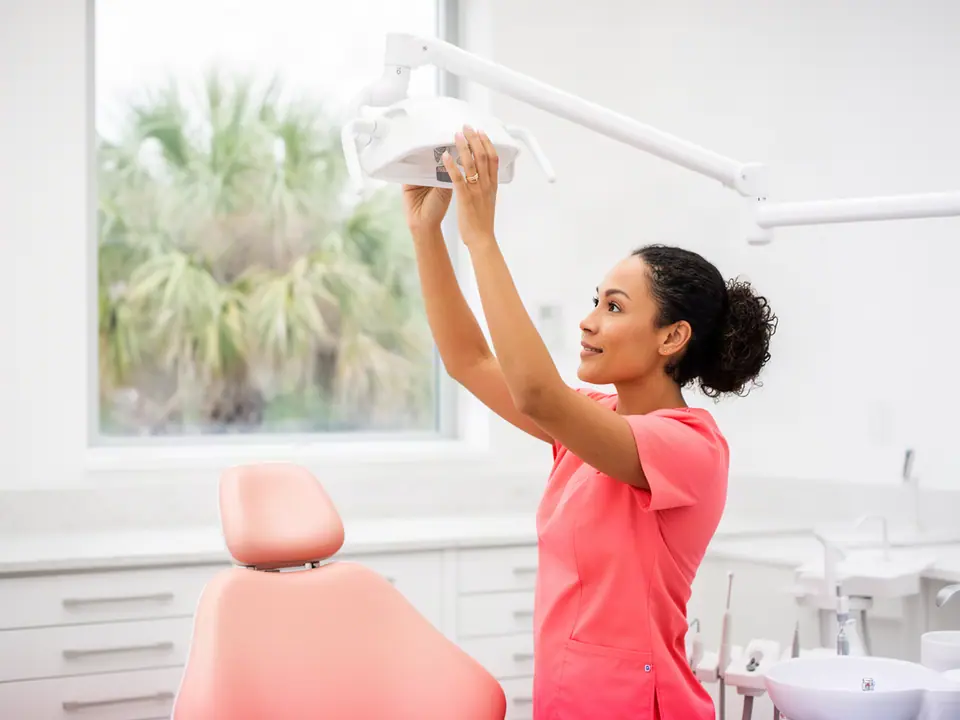
Dental practice purchase loans let a dentist in Mount Pleasant, SC buy an existing office or a partner’s share with a term loan sized to the price: charts, chairs, equipment and the team already in place. The building is not part of what Windharbor arranges. A funding partner reviews the purchase file and makes the decision.
Buying a dental practice in Mount Pleasant, SC: what the price covers, a buy-in example, equipment after closing and the file a lender reviews.
Dental practice purchase loans for an existing office
A dentist buying an established office takes over more than chairs. The price covers the patient base, the equipment, the supplies on the shelves and a team that already knows the schedule. For that reason a business term loan sized to the full price, with a long term, is the product that fits a purchase. The real estate under the practice is a separate deal and outside what Windharbor arranges; a buyer who leases takes over the lease or signs a new one with the landlord.
The pool of possible sellers in the county is easy to size. In 2023, 229 offices of dentists (NAICS 6212) in Charleston County, SC had paid staff, according to County Business Patterns; 72 of them, 31.4%, had fewer than five employees. Those offices together counted 1,718 employees in the March 2023 pay period. ZIP Code Business Patterns placed 48 dentist offices at a ZIP 29464 location that year. Nonemployer Statistics, a separate Census program, listed 98 dentist offices in the county with no paid employees for 2024.
Illustration only, invented figures: a buyer agrees to a $780,000 price for a Mount Pleasant, SC general practice, broken down below, puts in $78,000 of their own cash and asks about financing the remaining $702,000.
| Part of the price | Amount |
|---|---|
| Equipment and chairs | $190,000 |
| Patient records and goodwill | $560,000 |
| Supplies on hand | $30,000 |
| Purchase price | $780,000 |
Over ten years at an annual rate of 9.75%, the $702,000 balance carries a payment of $9,180.07 a month. The 120 payments total $1,101,608.40, which puts interest at $399,608.40 over the life of the loan. Whether a partner accepts that cash contribution, and which term it offers, is the partner’s call.
Financing a partner share or an associate buy-in
A buy-in is a smaller purchase with its own wrinkles. The associate buys a percentage of the practice, and the partnership or operating agreement sets the price, the vote that share carries and what happens if either dentist leaves. The valuation is the figure to settle first, since every later number flows from it.
Illustration only, invented figures: an associate pays $360,000 for a 30% stake in a practice valued at $1,200,000. Financed over seven years at an annual rate of 10.25%, the share costs $6,023.03 per month, and the 84 payments add to $505,934.52. If the practice earns $480,000 a year before owner pay, a 30% share of that is $12,000 a month, so the payment sits $5,976.97 below the monthly share. That cushion has to cover the associate’s own taxes and living costs too, so a thin margin is worth a second look before signing.
The dental practices page covers associate buy-ins alongside imaging and milling equipment for offices in Mount Pleasant, SC.
Equipment upgrades after the purchase closes
A new owner can sensibly wait a few months before replacing equipment, to see which rooms the schedule actually uses. When the time comes, equipment financing can sit beside the purchase loan instead of reopening it. The machine secures its own agreement, and the term can match the equipment’s useful life rather than the ten-year purchase term.
Illustration only, invented figures: a new owner prices a cone-beam CT unit at $98,000 and an intraoral scanner at $32,000, $130,000 in all. On a five-year equipment agreement at an annual rate of 9.9%, the pair runs $2,755.72 monthly, with $35,343.20 of interest across the term. Folded into a ten-year loan at 9.75%, the payment drops to $1,700.01, but interest climbs to $74,001.20, or $38,658.00 more than the shorter agreement, for a scanner that may be replaced well before year ten.
What a lender can review in a dental practice purchase file
A practice purchase file is larger than an equipment request because the lender is pricing a whole business. A lender can ask for any of the following, and the list for a given deal is set by the partner:
- The letter of intent or signed purchase agreement, with the price split between equipment, goodwill and supplies.
- The seller’s profit and loss statements and business tax returns for the years the partner names.
- Collections and production reports by month and by provider, including hygiene.
- The payer mix: insurance plans, fee-for-service and any membership plan the office runs.
- The current lease, the landlord’s consent to assign it, and the remaining term.
- A practice valuation, if one was ordered, and the buyer’s own license and personal financial statement.
Collections tell a partner more than production, since production is what was billed and collections are what arrived. A transition plan (how long the seller stays on, how patients hear about the change) also belongs in the file. Calling Windharbor or sending the short request form does not count as a credit application; a funding partner may check the buyer’s credit later, during its own review.
More funding articles for local practices are on the Windharbor blog.
By Windharbor Advances · Updated